Spores, Logs, and Basements: Vermont's Mushroom Cultivators Are Growing Something Special
There's a corner of a converted dairy barn in Washington County where the air smells like earth after rain, even in February. Shelves run floor to ceiling, stacked with white-flecked blocks of inoculated sawdust. Clusters of golden oyster mushrooms fan out from the sides like something from a fairy tale. The farmer tending them — a former high school biology teacher — is wearing a headlamp and a flannel shirt, doing what she does most mornings: checking for pinning, adjusting humidity, harvesting anything ready to go.
She sells to three restaurants in Montpelier and a rotating list of home cooks who found her through word of mouth. She doesn't have a website. She doesn't need one.
This is Vermont's mushroom underground — and it's more alive than you might think.
A Crop That Fits Vermont Perfectly
Mushroom cultivation has been quietly expanding across the state for years, tucked into the margins of Vermont's already-robust local food culture. It's not glamorous work. It requires attention to detail, tolerance for humidity, and a willingness to learn the particular personalities of different species. But it fits Vermont in a way that makes sense. The climate is cool, the forests are full of hardwood logs perfect for outdoor cultivation, and the community of growers — small, scrappy, and deeply curious — is exactly the kind that thrives here.
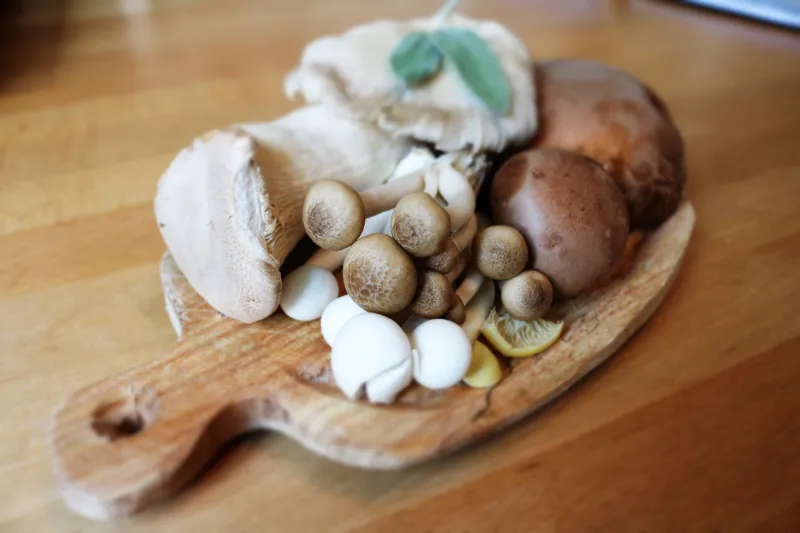
Shiitake and oyster varieties have been the gateway for most growers, and for good reason. They're forgiving, productive, and have an established market. But Vermont cultivators aren't stopping there. Lion's mane, with its shaggy white clusters and meaty texture, has become a favorite among chefs looking for something that can hold its own as a centerpiece dish. Reishi and turkey tail — prized more for their medicinal properties than their culinary ones — are showing up in the portfolios of growers who see the farm as something more than a food source.
Log Culture and the Long Game
One of the most distinctive practices among Vermont's mushroom growers is the use of inoculated hardwood logs — a technique that's older than almost any other cultivation method and one that pairs beautifully with Vermont's abundance of oak, sugar maple, and beech.
The process is slow by modern agricultural standards. Logs are drilled, packed with mushroom spawn, sealed with wax, and then left to colonize for anywhere from six months to a year before the first flush. Once they start producing, though, a single log can yield mushrooms for three to five years. Growers who've invested in log yards talk about them the way some people talk about orchards — something you tend carefully and return to season after season.
A grower outside of Brattleboro who started with a dozen shiitake logs in his backyard now manages over four hundred, stacked in shaded rows behind his house. He sells at the local farmers market from May through November and supplements with indoor cultivation during the winter months. "The logs taught me patience," he says. "Indoor growing taught me control. You need both."
The Indoor Side of Things
For growers who want year-round production, indoor cultivation has become the backbone of the operation. Spare bedrooms, basement corners, and purpose-built grow rooms are all fair game. The setup varies wildly — some growers invest in environmental controllers, automated misting systems, and grow tents; others keep it remarkably low-tech, relying on a cool room, a spray bottle, and careful observation.
What they share is an obsession with substrate — the growing medium that feeds the mycelium. Hardwood sawdust is the standard for most species, but cultivators experiment with straw, coffee grounds, cottonseed hulls, and various grain-based spawn to find what produces the best yields and the most flavorful fruit. It's part science, part intuition, and growers swap notes the way home brewers compare recipes.
There's a loose but real community forming around this knowledge-sharing. Online forums have given way to in-person meetups, informal workshops, and the kind of mentorship relationships that feel very Vermont — someone who's been doing it for ten years showing a newcomer how to sterilize substrate without contaminating a whole batch. It's collaborative in a way the agricultural world doesn't always manage to be.
What Chefs Are Doing With It
Restaurant kitchens across Vermont have taken notice. Chefs who've spent years trying to source interesting local ingredients are finding that specialty mushrooms check every box — they're grown nearby, available in quantities that work for small menus, and they bring genuine culinary interest to a plate.
Oyster mushrooms, with their delicate texture and mild flavor, get roasted, sautéed, and folded into pasta. Lion's mane gets sliced thick and seared like a steak — it caramelizes beautifully and has a texture that surprises people who think of mushrooms as a garnish rather than a main event. Shiitake adds depth to broths, braises, and grain dishes. And dried reishi shows up in everything from teas to slow-cooked sauces, adding an earthy bitterness that chefs are learning to use as a seasoning rather than a flavor.
The relationship between cultivators and chefs tends to be direct and personal. These aren't transactions routed through a distributor. A chef texts a grower on Tuesday to see what's flushing, and by Thursday those mushrooms are on the menu. That kind of supply chain doesn't just produce fresher food — it produces better cooking, because the chef knows exactly what they're working with and can plan accordingly.
More Than Food
It would be easy to frame Vermont's mushroom cultivators purely as food producers, but that misses something important about why so many of them got into it in the first place. Fungi exist at the intersection of food, medicine, ecology, and something harder to name — a kind of wonder at how these organisms work, how they break down organic matter and build something new from it, how they connect to the broader web of a forest ecosystem.
Growers who started out just wanting to produce good food often find themselves reading mycology, experimenting with species they'll never sell, and thinking about the role of fungi in soil health and forest regeneration. It's a rabbit hole, and most of them are happy to have fallen in.
That curiosity is good for Vermont's food scene. It means this isn't a trend that's going to peak and fade. The people growing mushrooms here are in it for the long haul — tending their logs, adjusting their grow rooms, and quietly building something that belongs entirely to this state and this moment.
Next time you're at a farmers market and you see a cooler full of unusual-looking clusters, stop and ask the person behind the table how they got started. You'll probably be there a while. And you'll go home with something worth cooking.