Grain to Strand: Vermont's Wheat Farmers Are Pulling Off a Pasta Revolution
There's a quiet assumption most of us carry into the kitchen: pasta comes from Italy. Or at least from somewhere with sun-baked fields, ancient durum varieties, and generations of nonnas who knew exactly how to feel the dough. Vermont — with its mud season, its rocky hillside farms, its winters that just don't quit — doesn't exactly fit that mental image.
And yet, something is happening in the Green Mountain State that's worth paying attention to. A growing number of Vermont farmers and food makers are growing heritage grain, milling it themselves, and turning it into pasta products that are landing on restaurant menus, farmers market tables, and kitchen shelves across the region. They're not trying to out-Italy Italy. They're doing something more interesting than that.
Why Wheat, Why Now
Vermont has a complicated history with grain. Before the dairy industry took over the agricultural landscape in the late 19th century, wheat and other small grains were actually common crops here. The soil wasn't always the limiting factor — economics were. Cheap Midwestern grain flooded eastern markets, and Vermont farmers pivoted to cows.
Fast-forward to today, and a regional grain revival is quietly but firmly underway. Organizations like the Kneading Conference movement and grain-focused agricultural networks have helped create infrastructure — mills, seed libraries, shared knowledge — that makes small-scale grain farming viable again. Vermont farmers are planting varieties like Red Fife, Einkorn, Rouge de Bordeaux, and Turkey Red, not because they're trendy, but because they perform well in the Northeast's shorter growing season and produce flour with genuinely complex flavor.
That flavor is the whole point. Heritage wheat varieties tend to have higher protein content and more nuanced taste profiles than commodity white flour — nuttier, earthier, sometimes with a faint sweetness that hits you after the first bite. For pasta makers, that's not a bug. That's the entire product.
The Agronomic Hustle
Nobody said it was easy. Growing grain in Vermont means contending with unpredictable spring moisture, late frosts, and the ever-present challenge of finding enough flat, workable acreage in a state defined by its hills. Farmers who've taken the leap describe a steep learning curve — figuring out the right planting windows, managing cover crops, sourcing equipment that's scaled for small operations rather than industrial Midwestern farms.
Then there's the milling. Many of the farmers getting into pasta aren't just growing wheat and handing it off to someone else. They're investing in stone mills, figuring out extraction rates, learning how ash content affects dough behavior. It's a lot of roles for one operation to hold — agronomist, miller, pasta maker, marketer — and the farmers doing it tend to describe the whole enterprise with a mix of exhaustion and genuine enthusiasm that feels distinctly Vermonter.
The payoff, they'll tell you, shows up in the dough. Freshly milled flour behaves differently than the stuff that's been sitting in a warehouse for months. It holds moisture differently, develops gluten differently, and brings something to the final product that's hard to describe but easy to taste.
From Field to Fettuccine
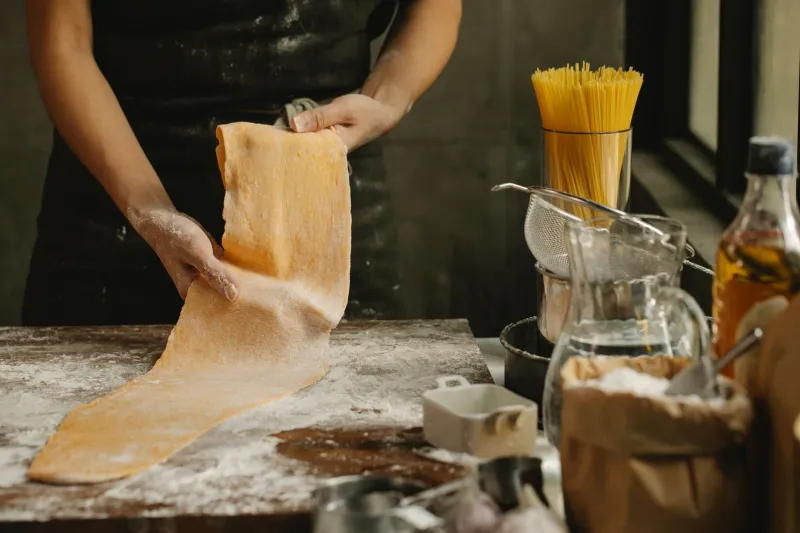
What does Vermont pasta actually look like in practice? It varies more than you might expect. Some producers are focused on fresh pasta — the kind that goes straight from the kitchen to the pot, with a texture that's silky and yielding and nothing like the dried stuff. Others are investing in the slower, more shelf-stable world of dried pasta, which requires more precise humidity control and a different approach to dough hydration but opens up a much wider distribution footprint.
Some operations are running the whole chain: growing grain, milling flour, making pasta, and selling direct at farmers markets or through farm store storefronts. Others are collaborating — a grain farmer partnering with a pasta maker, or a small mill supplying flour to a food entrepreneur who handles the production and sales end. The ecosystem is still young and a little loose, which means there's room for experimentation and also room for the kind of creative cross-pollination that tends to produce interesting food.
The shapes being produced range from the familiar — pappardelle, rigatoni, spaghetti — to more unexpected forms that play to the character of the flour being used. A wheaty, slightly rustic strand of whole-grain linguine made from Red Fife doesn't need to pretend it's something it isn't. It tastes like Vermont, and that's increasingly the point.
What It Tastes Like on the Plate
Chefs around the state are starting to take notice. Farm-to-table restaurants that have long sourced their vegetables and proteins locally are now asking a new question: where did this pasta come from? The answer, increasingly, can be a farm an hour away rather than a warehouse in New Jersey.
Cooks working with Vermont-grown pasta describe a product that stands up differently to sauce — it has more texture, more presence, more of what food people like to call chew. It pairs naturally with the kinds of ingredients Vermont produces in abundance: aged local cheeses, foraged mushrooms, braised heritage-breed pork, bitter greens from early spring fields. There's a coherence to a bowl of pasta made from Vermont wheat, dressed with Vermont butter, and finished with Vermont cheese that goes beyond farm-to-table talking points. It just tastes like it belongs together.
Home cooks who've discovered local pasta options describe a similar experience. The learning curve is minimal — you cook it the same way — but the reward is different. It's the difference between a meal and a meal with a story.
The Market Question
Here's where it gets real: can Vermont pasta compete commercially? The honest answer is that it doesn't have to compete the same way a commodity product does. The people making it aren't trying to undercut Barilla on price. They're building a different kind of value proposition — one rooted in transparency, flavor, and the kind of regional identity that resonates with consumers who are increasingly asking where their food comes from.
Farmers market sales are strong for producers who've gotten their product dialed in. Wholesale relationships with restaurants and specialty grocers are developing. A few producers are exploring online sales and subscription models that let them reach customers beyond the state. It's early days, but the trajectory feels real.
There's also a broader cultural current running in the same direction. Consumers are more curious about grain provenance than they were even five years ago. The sourdough boom during the pandemic sent a lot of people down a rabbit hole about flour, fermentation, and regional grain systems. That curiosity hasn't gone away — it's matured into something more durable.
A New Chapter for an Old Crop
Vermont's pasta makers aren't reinventing the wheel. Pasta is pasta — you still need water, flour, and either eggs or not, depending on what you're making. But they are reinventing the context: where the wheat grows, who tends it, how it's milled, and what it means to put a bowl of noodles on the table.
That might sound like a lot of weight to put on a plate of spaghetti. But food has always carried meaning alongside flavor. And in a state that has spent decades building a food identity around small farms, honest ingredients, and the stubborn belief that local can be better — not just different, but genuinely better — pasta made from Vermont wheat feels like a natural next chapter.
The noodles are good. The story behind them is even better. Pull up a chair.