Dirt First: The Vermont Farmers Who Stopped Chasing Yields and Started Listening to the Land
There's a moment that a lot of Vermont farmers describe the same way. They're standing in a field that should be performing — they've fed it, tilled it, coaxed it — and something still feels off. The crops come in, sure, but the land feels tired. Compacted. Like it's working against them instead of with them.
For Marcus Bellows of Bellows Hill Farm in Hardwick, that moment came during a particularly rough growing season about six years ago. "The yields were fine on paper," he says. "But I could feel the farm getting weaker. I just didn't have the language for it yet."
He does now.
What the Soil Report Actually Says
Marcus started working with an agronomist out of Montpelier who runs soil health panels that go well beyond the standard pH and nutrient tests most farms rely on. We're talking biological activity measurements — things like active carbon levels, fungal-to-bacterial ratios, water infiltration rates. Metrics that tell you whether the soil is actually alive, not just chemically present.
"The first report was humbling," Marcus says with a laugh. "My soil biology was basically flatlined. I had nutrients in the ground, but nothing to cycle them. I was farming a chemistry set, not an ecosystem."
This kind of reckoning is happening across Vermont, and it's reshaping what progressive agriculture looks like in the Green Mountain State. A growing cohort of farmers — some longtime growers, some newer to the land — are abandoning the conventional wisdom that productivity equals chemical inputs plus tillage, and replacing it with something older and simultaneously more cutting-edge: working with biological systems rather than around them.
Cover Crops as the New Infrastructure
Drive past the right farms in Addison County in late September, and you'll see fields that look almost lush — not with cash crops, but with sprawling mixes of oats, radishes, crimson clover, and hairy vetch. These are cover crops, and for farms like Clearwater Ridge in Vergennes, they've become as important as anything that actually gets sold.
Sophie Marchand, who runs Clearwater Ridge with her partner Desi, started experimenting with multi-species cover crop blends three years ago after attending a soil health workshop hosted by the Vermont Agency of Agriculture. "I was skeptical at first," she admits. "It felt counterintuitive to put all this effort into something you're just going to terminate in the spring."
But the results shifted her thinking fast. "Our water retention improved dramatically the first year. We had a dry August — really dry — and our fields held moisture in a way they never had before. The cover crops had built structure underground that we couldn't see but could absolutely measure."
The deep-rooted radishes in her mix, often called tillage radishes or daikon-style cover crops, break up compaction layers without mechanical tillage. The legumes fix nitrogen. The grasses add organic matter. By the time the cash crops go in, the soil has been prepped by biology rather than a plow.
The Agronomist in the Middle
Connecting farmers to this science is increasingly the work of independent agronomists and extension educators who've made soil biology their specialty. Claire Thiessen, who consults with about thirty Vermont farms, describes her job as translation work. "I'm taking laboratory data and turning it into farm decisions," she says. "But I'm also taking farmer observations — what they're seeing, what they're feeling about their land — and helping them understand what those observations mean biologically."
Claire is emphatic that this isn't about ideology. It's about outcomes. "Regenerative practices get labeled as this alternative, fringe thing, but the science is really solid. When you increase organic matter by even one percent, you dramatically improve water-holding capacity, nutrient cycling, and crop resilience. That's not a philosophy — that's chemistry and biology."
She's also careful to note that the transition isn't without friction. Farmers who move away from conventional tillage and synthetic inputs often see a dip in productivity during the adjustment period — sometimes two or three years of the soil biology rebalancing itself. "That's real," she says. "It's a genuine financial risk, and we need to be honest about it. That's why the support systems matter."
Beyond Bushels Per Acre
What's shifting most fundamentally for these farmers is how they measure success. Marcus Bellows now tracks his soil's organic matter percentage as closely as he tracks his sales numbers. Sophie Marchand celebrates her water infiltration rate like a harvest milestone. These aren't vanity metrics — they're indicators of long-term farm viability in a state where climate volatility is increasingly part of the calculus.
"We had a field that was basically eroding every time it rained hard," Marcus says. "Now that same field absorbs water. The topsoil is staying put. That's worth more to me long-term than any single yield number."
There's also a market angle that's becoming impossible to ignore. Vermont's farm-to-table food culture has created a consumer base that genuinely cares about how food is grown — not just whether it's local, but whether it's grown in a way that's building something rather than depleting it. Restaurants across Burlington, Stowe, and Woodstock are starting to ask questions about soil practices the same way they ask about breed or variety.
"We had a chef call us this spring specifically because she'd heard we were doing biological farming," Sophie says. "She wanted to know the story of the soil. That's new. That's exciting."
The Long Game
None of this is fast. Soil health is a decades-long project, and the farmers who've committed to it talk about their work in generational terms — what they're building for the next farmer, the next owner, the next iteration of this land.
Marcus puts it simply: "Conventional farming was always asking the land for something. What we're doing now is giving something back first. And honestly, the land is responding."
That response — measurable, documented, felt in the weight of the harvest and the color of the earth — is becoming the most compelling argument for a different kind of Vermont agriculture. One that starts not with what you can extract, but with what you can build.
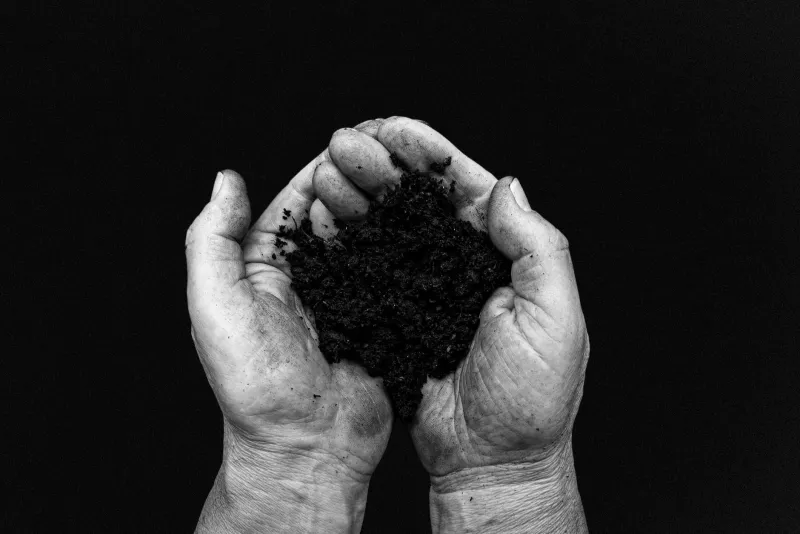
One handful of dirt at a time.