Bubbling Under: Vermont's Homegrown Fermentation Obsession Is Getting Deliciously Out of Hand
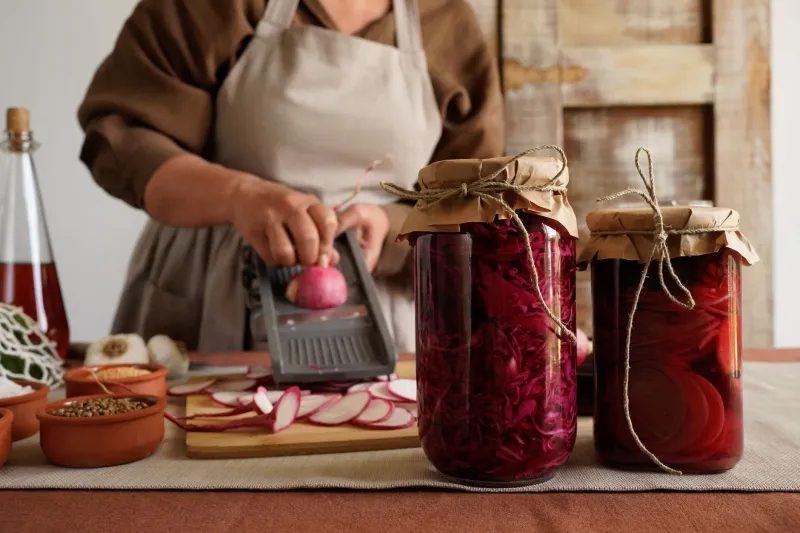
Somewhere in Vermont right now, a mason jar is doing something wonderful. Maybe it's a quart of shredded cabbage and salt sitting on a kitchen shelf in Montpelier, slowly transforming into sauerkraut. Maybe it's a gallon of sweet tea threaded with a rubbery SCOBY in a Burlington apartment, becoming kombucha. Maybe it's a crock of garlic dill pickles in a Craftsbury farmhouse, fermenting the old-fashioned way — no vinegar, no shortcuts, just salt and time and the invisible work of beneficial bacteria.
Vermont has always been a place that values doing things yourself, doing them carefully, and doing them with whatever the land provides. Fermentation fits that ethos so naturally it almost feels inevitable. But what's happening here right now goes beyond self-sufficiency. It's become a genuine subculture — part food science, part folk tradition, part wellness practice — and it's producing some of the most interesting preserved foods in New England.
Why Vermont? Why Now?
Fermentation isn't new, obviously. Humans have been preserving food through lacto-fermentation, wild yeast, and controlled bacterial activity for thousands of years. What's new is the enthusiasm — the way home fermenters are sharing knowledge, experimenting across cultural traditions, and building small businesses out of what started as kitchen curiosity.
Vermont's particular version of this revival has a few distinct flavors. There's the back-to-the-land thread, connected to the state's long history of homesteading and off-grid living. There's the farm abundance thread — when you're surrounded by more vegetables than you can eat fresh, preservation becomes a practical necessity. And there's the wellness thread, driven by growing awareness of the gut microbiome and the role of fermented foods in supporting it.
Throw in Vermont's general appetite for DIY culture, its tight-knit communities where skills get shared freely, and its proximity to a regional food scene that rewards small-batch, artisanal production, and you've got ideal conditions for a fermentation boom.
The Home Kitchen Underground
Talk to enough Vermont fermenters and you start to notice a pattern: it almost always starts with one thing. A friend brings over a jar of homemade kimchi. A partner picks up a copy of Sandor Katz's The Art of Fermentation. A farmers market vendor offers a sample of naturally fermented pickles and suddenly the grocery store version tastes hollow by comparison.
From that first spark, things tend to escalate. Sauerkraut leads to kimchi leads to miso leads to koji leads to a dedicated fermentation shelf, then a dedicated fermentation corner, then — in some cases — a dedicated fermentation room. Vermont homes, particularly older farmhouses with cool cellars and root rooms, turn out to be excellent fermentation environments.
The community aspect is real and it's warm. Fermenters trade starters and cultures the way gardeners trade seeds. SCOBY hotels — collections of spare kombucha cultures kept alive to share with newcomers — circulate through friend groups and community networks. Local libraries and community centers host fermentation workshops. Online groups specific to Vermont fermenters swap troubleshooting tips and recipe experiments with the kind of enthusiastic detail usually reserved for serious hobbyists.
From Crocks to Commerce: Small-Batch Producers Making Waves
For some Vermonters, the hobby eventually outgrows the kitchen. A handful of small-batch fermentation businesses have emerged in recent years, turning personal obsession into livable livelihoods. These aren't industrial operations — they're cottage-scale producers making kimchi, krauts, kvass, tepache, and wild-fermented hot sauces in quantities that reflect genuine craft rather than mass production.
What sets Vermont's small fermenters apart is their sourcing. Many work directly with local farms, using whatever vegetables are abundant and in season. A late-summer glut of Napa cabbage becomes the foundation of a kimchi run. A surplus of Gilfeather turnips — Vermont's beloved heirloom variety — gets fermented into something unexpected and quietly spectacular. The seasonality that defines Vermont's farm-to-table restaurant scene shows up in the pickle jar too.
Some of these producers sell at farmers markets, others through local food co-ops, and a growing few have built direct-to-consumer businesses that ship beyond state lines. Vermont's reputation as a source of quality, values-aligned food gives these small operations a credibility boost that a producer in a less storied food region might not enjoy.
A Recipe to Try: Simple Lacto-Fermented Dill Pickles
The best entry point into home fermentation is almost certainly the classic dill pickle. No special equipment required, no vinegar, and the results — crisp, tangy, complex in a way that store-bought pickles simply aren't — are almost guaranteed to turn you into a convert.
What you need:
- 1 lb small cucumbers (Kirby or pickling varieties work best)
- 2 cups filtered or non-chlorinated water
- 1 tablespoon non-iodized salt (kosher or sea salt)
- 3-4 cloves garlic, smashed
- A generous handful of fresh dill — fronds and stems
- Optional: a grape leaf, oak leaf, or horseradish leaf (the tannins help keep pickles crisp)
- A clean quart mason jar
How to do it:
Dissolve the salt in the water to make your brine. Pack the cucumbers tightly into the jar, tucking in the garlic, dill, and your tannin leaf if using. Pour the brine over everything, making sure the cucumbers are fully submerged — use a small zip-lock bag filled with extra brine as a weight if needed. Cover loosely with a cloth or loosely fitted lid to let gases escape.
Leave at room temperature for 3-5 days, tasting daily after day two. The pickles will turn from bright green to a more olive shade as fermentation progresses. When they taste right to you — tangy, garlicky, deeply dilly — move them to the fridge. They'll keep for months, and the flavor keeps developing.
The Wellness Angle (Without the Hype)
It would be dishonest to ignore the gut health conversation entirely, but it's also worth keeping it grounded. Fermented foods do contain live beneficial bacteria, and there's genuine scientific interest in the relationship between fermented food consumption and microbiome diversity. Vermont fermenters tend to talk about this with appropriate nuance — they're not claiming their sauerkraut cures anything, but they've noticed they feel better when fermented foods are a regular part of their diet, and that's enough.
What's more interesting, honestly, is how fermentation reconnects people to the process of food — to the idea that what you eat is alive, that transformation takes time, that patience is an ingredient. In a food culture that often defaults to instant and convenient, there's something genuinely radical about tending a crock on your counter and watching something delicious emerge over the course of a week.
Vermont has always understood that the best things take time. The fermenters here are just applying that wisdom to the jar.