Eating Vermont All Year: How Local Home Cooks Are Mapping Their Kitchens to the Calendar
Somewhere between the last of the winter squash and the first rhubarb of spring, there's a gap. Veteran Vermont home cooks know it well. They've named it, planned for it, and found ways to eat through it without reaching for a bag of California lettuce or a box of something shipped from three time zones away. That gap — roughly late February into April — is the final exam for anyone trying to build a truly local kitchen, and the cooks who've passed it have stories worth hearing.
This isn't a trend born from social media challenges or a fleeting interest in clean eating. It's a slower, quieter shift happening in farmhouse kitchens, apartment pantries, and suburban dining rooms across the state. Vermont home cooks are designing their annual eating patterns around what the land actually produces, and they're getting remarkably good at it.
The Month-by-Month Mindset
For Dorset-based home cook Mara Ellison, the whole system starts with a notebook. Every October, she maps out the following twelve months in rough strokes — what she expects to have preserved, what she'll be sourcing from nearby farms, and where the lean spots are likely to fall. It sounds methodical, but she laughs when she describes it.
"It's less of a spreadsheet and more of a conversation with myself," she says. "I'm asking: what did I run out of last March? What did I have too much of in July? And what do I actually want to be eating in January?"
Her January looks a lot like root vegetables roasted with dried herbs, bean soups built from summer harvests she pressure-canned in August, and the occasional treat of aged local cheese with apple preserves. By March, she's leaning hard on fermented vegetables, frozen corn from a farm stand in Addison County, and the last of the storage apples from an orchard she's been buying from for six years.
The strategy isn't about deprivation. It's about front-loading effort. "Summer is when I'm basically working two jobs," she says. "One job is cooking dinner. The other job is making sure February me has something good to eat."
Preservation as a Year-Round Strategy
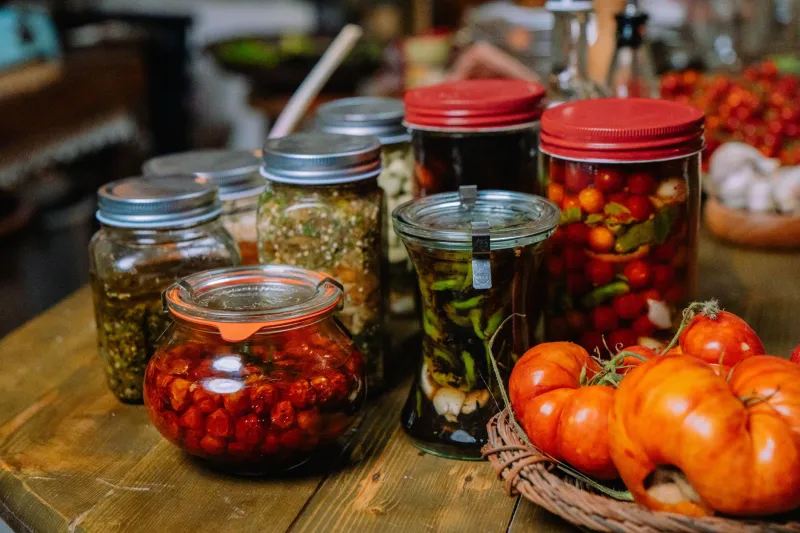
The preservation methods Vermont home cooks rely on read like a short history of food storage itself: canning, fermenting, freezing, cellaring, drying, and curing. What's changed is how intentionally these techniques are being layered together.
In Burlington, a home cook named Theo Marchetti has turned his basement into what he calls a "cold library." Shelves of canned tomatoes share space with crocks of kimchi made from Vermont-grown napa cabbage, jars of pickled fiddleheads from a forager he met at the Montpelier farmers market, and a small freezer packed with vacuum-sealed portions of pastured pork from a farm in Hardwick. He spent three summers refining the system before it felt truly reliable.
"The first year I tried this, I ran out of tomatoes in November," he says. "Now I can tell you exactly how many quarts I need to get through to the following August. It took some failure to figure that out."
Freezing gets less romantic attention than canning or fermenting, but it's the backbone of most serious local kitchens. Blanched green beans, roasted beet purée, shredded zucchini, herb oils — these are the quiet heroes of a February dinner.
Building the Sourcing Relationships That Make It Work
No local pantry runs on preservation alone. The cooks who've made this lifestyle stick almost universally credit their sourcing relationships — the farmers, cheesemakers, grain millers, and meat producers they return to year after year — as the real infrastructure.
For Keene Valley transplant and now full-time Vermonter Julia Sato, this meant spending her first two years in the state doing what she calls "intentional shopping." Instead of buying from whoever had a booth at the market, she started asking questions. Who had a winter CSA? Which dairy would sell her a quarter wheel of aged cheese in November? Was there a grain mill willing to do a bulk order?
"Vermont is small enough that you can actually build these relationships," she says. "A farmer here will text me when they have something unexpected. Last fall I got a message about surplus delicata squash, and I bought forty pounds. That kept us going through January."
The informal economy around these connections is part of what makes Vermont's local food system genuinely functional rather than aspirational. It's not just farmers markets and CSA boxes — it's text messages and handshake agreements and a mutual understanding that both sides benefit from showing up consistently.
When the System Gets Tested
Even the most prepared Vermont kitchen hits friction points. The late-winter gap is the most common culprit, but there are others: a bad harvest year for a key crop, a producer who stops selling retail, a preservation batch that doesn't seal right.
Mara Ellison lost a full shelf of canned green beans two winters ago when a jar seal failed and she didn't catch it in time. Her response wasn't to abandon the project — it was to diversify. She now splits her preservation across at least three methods for any ingredient she considers essential. Tomatoes get canned, frozen as sauce, and dried. Herbs go into the freezer and into oil. The redundancy adds work in the short term and peace of mind across the rest of the year.
There's also the question of what "local" means when you're trying to eat this way twelve months in a row. Most of these cooks have drawn their own lines. Coffee and citrus are common exceptions. Olive oil shows up in many of these kitchens without apology. The goal isn't purity — it's proportion. If ninety percent of what's on the table came from within a hundred miles, that's a win worth celebrating.
What It Gives Back
Ask any of these cooks why they do it, and the answers eventually move past practicality into something harder to quantify. There's a rhythm that comes with eating this way — a sense of being genuinely synced up with where you live. The first asparagus of May hits differently when you've been waiting for it since October. A bowl of butternut squash soup in December carries the memory of the August afternoon you roasted and froze it.
"I feel like I actually know where I live now," Julia Sato says. "Not just geographically. Like, I know what this place tastes like in every month of the year. That means something to me."
Vermont has always had a culture of self-sufficiency woven into its character — the kitchen garden, the root cellar, the pantry stocked against a hard winter. What these home cooks are doing is less a reinvention of that tradition than a thoughtful update of it, adapted to modern lives and modern farms, but rooted in the same basic idea: that the land around you is enough, if you pay attention to it.